
'We were all delighted with your wonderful children, how good they were and how well they participated.'
School Visitor
Why mental health and wellbeing is a priority in School?
We use the World Health Organisation’s definition of mental health and wellbeing “a state of well-being in which every individual realises his or her own potential, can cope with the normal stresses of life, can work productively and fruitfully, and is able to make a contribution to her or his community”. [1]
Mental health and wellbeing is not just the absence of mental health problems; we want all children/young people to:
• feel confident in themselves.
• be able to express a range of emotions appropriately.
• be able to make and maintain positive relationships with others.
• cope with the stresses of everyday life.
• manage times of stress and be able to deal with change.
• learn and achieve.
We recognise that good mental health and emotional wellbeing is as important in our lives as good physical health. We know that children’s mental health is a crucial factor in their overall wellbeing and can affect their learning and achievement. It is a sad statistic that 1 in 6 children aged 5-16 likely to have a mental health problem.[2] The Good Childhood Report found almost a third of the children and young people they surveyed in 2023 were unhappy with at least one of the ten specific areas of their lives that they were asked about.[3]
[1] 17 June 2022 https://www.who.int/news-room/fact-sheets/detail/mental-health-strengthening-our-response)
[2] Mental Health of Children and Young People in England, 2020: NHS digital, 22 October 2020).
[3] The Children’s Society 2023
• We help children to form and maintain healthy relationships with key staff as well as peers.
• We help children to feel comfortable about sharing any concerns or worries without feeling any stigma by creating an open culture where it’s normal to talk about mental health.
• We teach children emotional skills and an awareness of mental health so that they understand their own emotions and feelings better.
• We help children to be resilient learners and to manage setbacks.
• We provide both staff and pupils opportunities to reflect.
• We identify children who have mental health challenges and create plans to support their needs, including working with specialist services, parents and carers.
• We support and train staff to develop their skills and their own resilience and we recognise the importance of protecting staff mental wellbeing.
Dorset Mental Health Support in Schools (MHST)
MHST stands for Mental Health Support Team, an NHS-led service in England that provides early intervention for children and young people (ages 4-18/Year 13) experiencing mild to moderate mental health issues like anxiety and depression, working directly in schools to offer support, training for staff, and promoting whole-school wellbeing. They use evidence-based approaches, primarily Low-Intensity Cognitive Behavioural Therapy (LI-CBT), to help students develop coping strategies and manage big feelings, aiming to prevent issues from worsening.
https://dorsethealthcare.pagetiger.com/mhst-service
What MHSTs Do:
Who They Help:
How They Work:
Young Carers
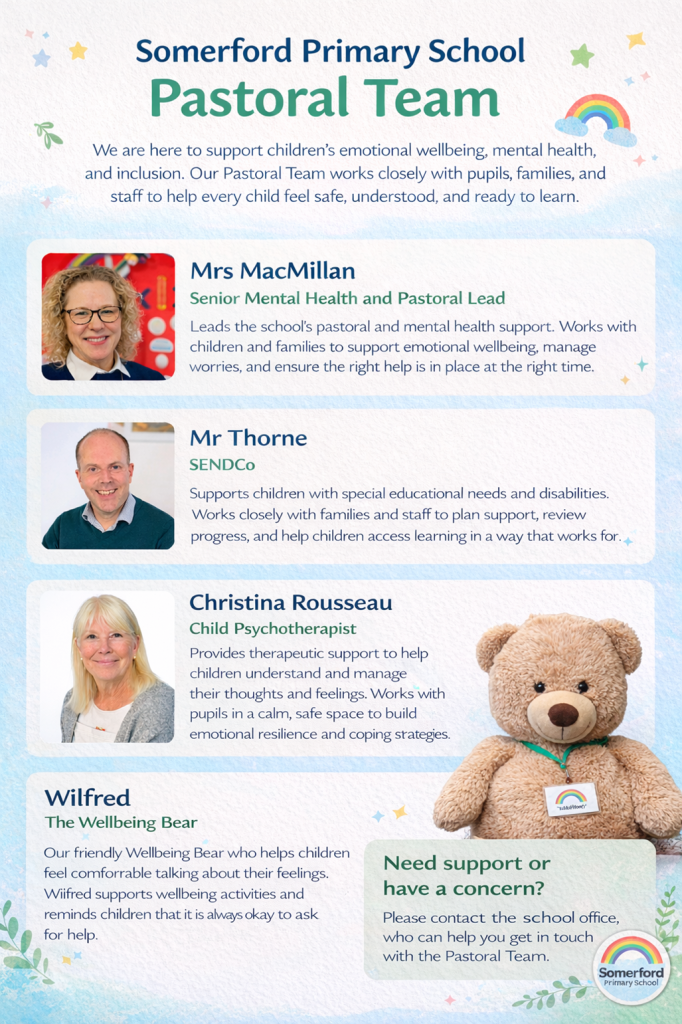
We often have 20 – 30 children in this group across the school at SPS and they meet half termly with Mrs MacMillan (Young Carer champion). Children are part of the young carers group because they have someone in their immediate family who has a disability, physical or mental health issue which requires them to give extra care and support within the family in some way.
Children benefit from attending this group as they can share how they feel and talk about the issues they face at home with other children who have similar experiences and understand how it can make you feel.
The children also do fun games and craft activities during the session. Also, there are times when we can take the children out for activities in the local community, such as visiting the Hamworthy Beach and Park.
The BCP Young Carers Service
Many families share tasks and support within their homes. Young Carers are those children and young people who have wider responsibility within the family than their peers, because of the needs of the person being cared for. Children can be referred to the BCP Young Carers Service by their parents/carers or professionals if they meet certain criteria.
More information on Young Carers can be found on the BCP Family Information Directory website.
MyTime Young Carers Support
Parents can refer their child who is a Young Carer to MyTime, please see link below.
Stormbreak
About stormbreak
Stormbreak aims to improve children’s mental health through movement, equipping them with sustainable, transferable skills and coping strategies to thrive during the complex demands of growth into adult life. We aim to embed mentally healthy movements for every child, every day until the life of our schools.
Core beliefs:
Useful Links for parents to access support
Urgent and Crisis Support (UK-wide)
If you are feeling overwhelmed or at risk:
If there is immediate danger, call 999 and ask for an ambulance.
Local Dorset and BCP Services
ChatHealth Dorset
Confidential text support for young people aged 11 to 19.
Text: 07480 635511
UP in BCP
Support for young people in Bournemouth, Christchurch and Poole.
Tel: 07880 480602
Website: http://www.upinbcp.co.uk
Nu-Waves (Weymouth area)
Support for children and families, including domestic abuse support.
Facebook page: http://www.facebook.com/dorsetnuwaves
(Service availability may vary. Contact directly for current support.)
The Rendezvous, North Dorset
Youth counselling and emotional support in Sherborne.
Website: https://www.therendezvous.org.uk
Treads, Blandford
Advice and drop-in support for young people.
Website: https://treadsblandford.wordpress.com
(Opening times may vary.)
Kooth
Online counselling and wellbeing support for young people.
Website: https://www.kooth.com
Dorset Mind Your Head
Whole-school and community mental health support.
Website: https://dorsetmindyourhead.co.uk
Healthwatch Dorset
Local health and social care feedback and advocacy.
Website: https://www.healthwatchdorset.co.uk
LiveWell Dorset
Public health and wellbeing support.
Website: https://www.livewelldorset.co.uk
The Discovery Project
Recovery-focused mental health support.
Services for Specific Needs
Autism Wessex
Tel: 01202 483360
Email: enquiries@autismwessex.org.uk
Website: https://www.autismwessex.org.uk
Mosaic Family Support
Bereavement support for children and families.
Tel: 01258 837071
Email: info@mosaicfamilysupport.org
Website: https://www.mosaicfamilysupport.org
Space Youth Project
Support for LGBTQ+ young people.
Tel: 01202 205279 or 07973 405280
Email: hello@spaceyouthproject.co.uk
Website: https://www.spaceyouthproject.co.uk
Young People’s Eating Disorder Service (YPEDS)
Accessed via NHS referral, usually through GP or CAMHS.
STARS Dorset
Rape and sexual abuse support.
Helpline: 01202 308855
Website: https://www.starsdorset.org
The Shores (SARC)
24 hour support following sexual assault.
Tel: 01202 552056
Website: https://www.theshores.org.uk